Time to continue our discussion on the eight point story arc, using The Lion, the Witch, and the Wardrobe as an example. The eight parts are as follows.
1. Stasis
2. Trigger
3. The quest
4. Surprise
5. Critical choice
6. Climax
7. Reversal
8. Resolution
Here's a reminder of the definition for the quest-
The quest
The trigger results in a quest – an unpleasant trigger (e.g. a
protagonist losing his job) might involve a quest to return to the
status quo; a pleasant trigger (e.g. finding a treasure map) means a
quest to maintain or increase the new pleasant state.
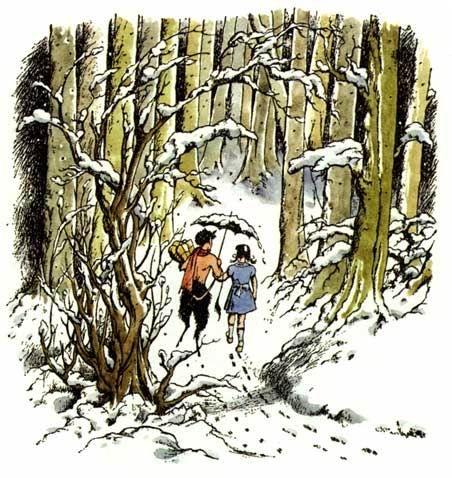
Last time we talked about the trigger, which involved the four children entering Narnia through the wardrobe. This is the transitionary point where the quest begins, and the quest is one of discovery and adventure. What follows is part of the plot synopsis from wikipedia.
Soon after entering Narnia, the children meet Mr. and Mrs. Beaver, who invite them
to dinner. The beavers recount a prophecy that the witch's power will
fall when two Sons of Adam and two Daughters of Eve fill the four thrones at Cair Paravel. The beavers tell of the true king of Narnia, a great lion named Aslan, who has been absent for many years but is now "on the move again."
The quest begins to explore Narnia, defeat the White Witch, find Aslan, and fulfill the prophecy.
The quest is the real heart of any story.
Get the girl/guy.
Find the treasure.
Discover the killer.
The list goes on and on, but it's important to remember that the quest is only made interesting by the way your characters (especially the protagonist) are affected by it and how they react to what's going on.
Your idea for a story might be the greatest thing since sliced bread, but even the greatest quest can be turned into a school textbook entry if you don't utilize your characters and make it relatable to your readers.
Any comments about the quest of your own story or something you're currently reading? Leave them below. Next time we'll talk about surprise!
A blog about writing, self publishing, self marketing, and Science Fiction and Fantasy.
Search This Blog
Showing posts with label Eight Point Story Arc. Show all posts
Saturday, March 9, 2013
Tuesday, March 5, 2013
The Eight Point Story Arc- The Trigger
Well, I'm finally back to discussing the Eight Point Story Arc. Wonders may never cease!
The eight components identified by Nigel Watts in his book Writing A Novel and Getting Published, which I've just ordered for my kindle, are as follows.
1. Stasis
2. Trigger
3. The quest
4. Surprise
5. Critical choice
6. Climax
7. Reversal
8. Resolution
Here is the definition of the Trigger listed from the Daily Writing Tips website.
The Trigger
Something beyond the control of the protagonist (hero/heroine) is the trigger which sparks off the story. A fairy godmother appears, someone pays in magic beans not gold, a mysterious letter arrives … you get the picture.
So what was the trigger in The Lion, The Witch, and the Wardrobe? The simplest answer is that it happens when Lucy enters the wardrobe, and is transported to Narnia to meet Mr. Tumnus.
The trigger in this book could also be considers as having three parts-
1. It begins when the children move to the mansion. This is a major disruption to their lives, and can be viewed as the start of their adventure. (We see this becoming especially true after reading The Magician's Nephew)
2. Lucy passes through the wardrobe into Narnia. I would say this is the "Well, duh!" trigger. This is obviously a major turning point and the true beginning of adventure.
3. All four children pass through the wardrobe into Narnia. Here we see the trigger come to a conclusion and this is where the quest truly begins. It could also be argued that the quest begins after Lucy enters alone, and tries to convince her siblings of the existence of Narnia, but I'll talk more about this next time.
When writing your story, can you define a clear and intriguing trigger? I recently read a book (no, I won't disclose the title) where the only clear trigger I could find came about 5/6ths of the way through the book. Although some boring things happened in this horrible bore of a book, it seemed like the first 5/6ths of the book was stasis. Don't make the same mistake, establish stasis for your characters and then start pounding them over the head with the universe!
In Michael Belmont and the Tomb of Anubis, the trigger happens when Micheal's parents disappear, he then must go on a quest to find them.
Want to send your characters on an exciting quest? Make sure you establish stasis and then 'pull the trigger' Your story will thank you for it!
Tuesday, January 24, 2012
The Eight Point Story Arc - The Stasis
Today I'm going to continue my discussion on the eight point story arc. The eight parts are as follows.
1. Stasis
2. Trigger
3. The quest
4. Surprise
5. Critical choice
6. Climax
7. Reversal
8. Resolution
It's time to focus on the stasis. Here's a reminder of the definition.
Stasis
This is the “every day life” in which the story is set. Think of Cinderella sweeping the ashes, Jack (of Beanstalk fame) living in poverty with his mum and a cow, or Harry Potter living with the Dursley’s.
So, using The Lion, The Witch, and the Wardrobe as an example, the stasis finds the four Pevensie siblings— Peter, Susan, Edmund, and Lucy, being evacuated from London to escape the Blitz. They are sent to live with Professor Digory Kirke out in a large house in the English countryside, so that they can be sheltered from the war and continue their lives in some kind of safety and stability.
The Stasis section of this book is interesting because there is already so much going on. The children have already had their lives disrupted because of the war and having to relocate. They are already in the midst of a horrible adventure, but during this period of history (1940s during World War II) most everyone in Europe is stuck in the same nightmare. It is out of this point of troubled stasis that the story really takes a turn with the Trigger, which we'll discuss during the next post.
Thursday, December 15, 2011
The Eight Point Story Arc
Today I'd like to begin to talk about the 8 point story arc I've been reading about lately. This article was pointed out to me from Karl Drinwater's blog.
The eight components identified by Nigel Watts in his book Writing A Novel and Getting Published, which I've just ordered for my kindle, are as follows.
1. Stasis
2. Trigger
3. The quest
4. Surprise
5. Critical choice
6. Climax
7. Reversal
8. Resolution
Here are the definitions listed from the Daily Writing Tips website.
I'd like to talk about all of these components one at a time, but before I do that, I thought I'd try to break down and find each of them in a familiar story, and will be using The Lion, the Witch, and the Wardrobe as an example.
The eight components identified by Nigel Watts in his book Writing A Novel and Getting Published, which I've just ordered for my kindle, are as follows.
1. Stasis
2. Trigger
3. The quest
4. Surprise
5. Critical choice
6. Climax
7. Reversal
8. Resolution
Here are the definitions listed from the Daily Writing Tips website.
Stasis
This is the “every day life” in which the story is set. Think of Cinderella sweeping the ashes, Jack (of Beanstalk fame) living in poverty with his mum and a cow, or Harry Potter living with the Dursley’s.
Trigger
Something beyond the control of the protagonist (hero/heroine) is the trigger which sparks off the story. A fairy godmother appears, someone pays in magic beans not gold, a mysterious letter arrives … you get the picture.
The quest
The trigger results in a quest – an unpleasant trigger (e.g. a protagonist losing his job) might involve a quest to return to the status quo; a pleasant trigger (e.g. finding a treasure map) means a quest to maintain or increase the new pleasant state.
Surprise
This stage involves not one but several elements, and takes up most of the middle part of the story. “Surprise” includes pleasant events, but more often means obstacles, complications, conflict and trouble for the protagonist.
Watts emphasises that surprises shouldn’t be too random or too predictable – they need to be unexpected, but plausible. The reader has to think “I should have seen that coming!”
Critical choice
At some stage, your protagonist needs to make a crucial decision; a critical choice. This is often when we find out exactly who a character is, as real personalities are revealed at moments of high stress. Watts stresses that this has to be a decision by the character to take a particular path – not just something that happens by chance.
In many classic stories, the “critical choice” involves choosing between a good, but hard, path and a bad, but easy, one.
In tragedies, the unhappy ending often stems from a character making the wrong choice at this point – Romeo poisoning himself on seeing Juliet supposedly dead, for example.
Climax
The critical choice(s) made by your protagonist need to result in the climax, the highest peak of tension, in your story.
For some stories, this could be the firing squad levelling their guns to shoot, a battle commencing, a high-speed chase or something equally dramatic. In other stories, the climax could be a huge argument between a husband and wife, or a playground fight between children, or Cinderella and the Ugly Sisters trying on the glass slipper.
Reversal
The reversal should be the consequence of the critical choice and the climax, and it should change the status of the characters – especially your protagonist. For example, a downtrodden wife might leave her husband after a row; a bullied child might stand up for a fellow victim and realise that the bully no longer has any power over him; Cinderella might be recognised by the prince.
Your story reversals should be inevitable and probable. Nothing should happen for no reason, changes in status should not fall out of the sky. The story should unfold as life unfolds: relentlessly, implacably, and plausibly.
Resolution
The resolution is a return to a fresh stasis – one where the characters should be changed, wiser and enlightened, but where the story being told is complete.
(You can always start off a new story, a sequel, with another trigger…)
I’ve only covered Watts’ eight-point arc in brief here. In the book, he gives several examples of how the eight-point arc applies to various stories. He also explains how a longer story (such as a novel) should include arcs-within-arcs – subplots and scenes where the same eight-point structure is followed, but at a more minor level than for the arc of the entire story.
I'd like to talk about all of these components one at a time, but before I do that, I thought I'd try to break down and find each of them in a familiar story, and will be using The Lion, the Witch, and the Wardrobe as an example.
Subscribe to:
Posts (Atom)
